ZiNnYc wrote:
I'm curious as to the reasons of why you chose/designed some of your aero, and am awaiting some hard dyno numbers on that engine with your ported head technique. S2z Reply:
Thanks! I'm just as curious as anyone else is about the Dyno Numbers, including Gary Watts (the owner of Z Sports in Everett, WA) who saw my heads and got very excited about the quality of my work (not bragging). In fact Gary's first question was "You have access to a CNC to do your porting with?" The look on his face was classic when I repied, I did this all by hand (except for the guide tapering).
I designed a special carbide tool to accomplish the guide tapering... I had the opportunity to work some SBC R & D with Don Gumke, who owned an automive machine shop (Complete with Engine Dynameter, and a SuperFlow 600 Flowbench. Don also owned the local dirt track and a Modifed Race car in Jamestown ND.
The race legal mods I did resulted in an exact what I calulated from the Flow Bench to the Dyno runs (638 hp). However, it was a totally different application and engine, normally asperated running straight Methanol.
Really doesn't apply to our Z32s. So and time and funds permit, I'll make progress on my new engine... ZiNnYc wrote:
For example, the use of spiroid technology on your spoiler. S2z Reply:
I actually like this question, because its unobtrusive and shows a willingness to at least understand.
Thank-you! Hopefully my reply will shed some light on its design...
I guess I'll start with the rear wing, which is just an extension of the Z32 TT Rear Spoiler contours (or loft). If you look at full bodied modern Drag Race cars, you'll notice this same type of "spoiler extension".
It's purpose is to keep the high pressure air separated from the low pressure air coming from beneath the vehicle.
Keeping this flow separated reduces the turbulence created when the flows "interact" at the back of the vehicle.
By reducing this turbulence, drag is reduced, and allows the vehicle to utilize the horsepower gained by the reduction in drag to achieve a higher top end speed. Next is the dual layer Diffuser. My "insperation" of such was admittedly F1.
Having raced in the ACRL, the car I drove ('87 Tiga) also had a rear diffusser, which you better believe I spent some significant time studying!
Why? Because it created significant downforce!
So while the rear spoiler extension was separating the airflows, I still need to make downforce.
I studyied averything I could lay my hands on about the modern F1 rear diffusers, you would be surprised at all of the available information found on some internet sites.
I combined the internet information with a book I purchased a long time ago, Race Car Aerodynamics by Joseph Katz &
Race Vehicle Dynamics by W.L Milliken & D.L Milliken
(Excellent books! I highly recommend reading it...)
Some quick hand calculations, and undercar measuring got me very close.
I modeled my diffuser in Solid Works, borrowed a Faro Arm from work (with permission of course) and created a point cloud in SW from the point file.
I admit that my model is not nearly as detailed as what Ni[X]it has shown on this forum, but my computer was struggling with all of the data.
I ended up "simplifying the model" to reduce the calculation time and finally get some results. Are they accurate?
Your guess is as good as mine!
High speed testing will only reveal the truth, of which I haven't had the luxury of accomplishing ...Yet! But how do you get the air under the vehicle to create downforce?
This was the one of the primary reasons for choosing the Invader II Front body kit. You will notice that this kit has a raised center in the front wing, just like modern day F1 cars.
In the early 90's, Tyrell F1 discovered that you really can't prevent air from getting under the chassis. So rather than fight it, they took advantage of it.
I discovered, that the Invader II actually increases the amount of airflow under the car (compared to OEM).
So I capitolized on this feature, and improved upon it by modifying the kit, and adding the side skirts. The side skirts act to channel the air under the car towards the rear diffuser, that's it!
They do NOT need to form a "perfect seal", that is not the design intent.
Trying to achieve a perfect seal is a total waste of time, however, if the side skirts are used to segrigate, and direct (channel) the air, then their use is much more effective. So now I have some down-force, am keeping the turbulence down, where to next?
I worked for Aviation Partners - Boeing, our sister company is Aviation Partners International, who own the patent for aircraft Spiroids. APB attempted to fit Spiroids on the Boeing 777, but could not get the business case to work. Technically, it worked, they couldn't make the business case. Joe Clark (CEO of API) modified his Flacon 50 business jet to prove they work:
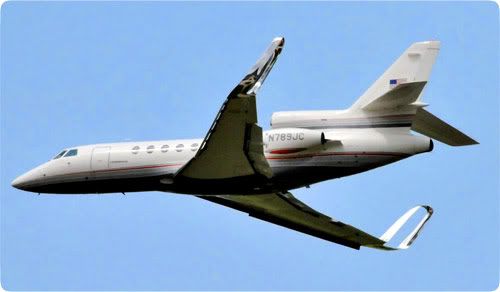 Spiroids create counteracting vortices coming off the wing to reduce drag. They are so effective, that 8-10% Fuel savings is achieved.
Impressive, but that's a high speed aircraft, not a vehicle on the ground.
Yes! However, the principles would still be relevant, especially if you think, isn't the shape of the 300ZX very similiar to a wing?
Absolutely!
Because of the differences in operating enviornments (speed),
it was at least obvious to me that simply copying the API spiroid would not be as effective as if I did an application specific design.
More studying, and running the simplified CFD models on the changes I incorporated finally gave me the design.
What is noteworthy, is that my first ideas were completely wrong, I even considered scrapping the idea altogether!
Through persistance (and a helluva lot of thought), I finally came up with a design that I felt would work and gave reasonable / predictable results with my CFD models. Spiroids work very similiar to the way a spoiler extension works, well at least the net effect is very similiar:
They reduce drag.
They reduce drag by creating counter-acting vortices coming off of the wing (in this case vehicle), which "tricks"the airflow into (for lack of a better explanation) "thinking" the frontal area is smaller than it actually is. Smaller frontal area, less drag= higher top end or "free horsepower". When I designed the aero package for my Z, the goal was to have as neutral handling as possible, while keeping understeer and oversteer at a minimum. I took a systems integration approach to the design, using as many factors as I could think of.
I'll be the first to admit, that I didn't think of everything, something will most certainly wag it's ugly head once I get into a test regime. But overall I'm happy with the design and execution of it. Yeah, Yeah, Yeah, I know, its not everyone's cup of tea... I didn't build it for anyone, I built it for myself...
I guess that's the point. If someone were to copy my work, well, more power to 'em.
You know what they say; Imitation is the sincerest form of flattery.
If someone doesn't like my design, well, fine that's your business, again, I didn't build it for you anyway! :) At least now, you have some insight on the how's and why's the design is what it is...
|


